20091010

Parabéns! | Programa de musicoterapia da Cal State Northridge


Media Contact: Carmen Ramos Chandler | carmen.chandler@csun.edu
(NORTHRIDGE, Calif., Oct. 2nd, 2009) ― When Cal State Northridge’s music therapy program started 25 years ago, it didn’t have an office. And some people on campus weren’t even sure what the program was.

But under the guidance of music professor Ron Borczon, the program and its Music Therapy Wellness Clinic have grown into nationally recognized institutions whose graduates and therapists are making a difference in the lives of children and adults around the world.

“When I was brought here to start the program in 1984, we had three students in the major. Today we have 28 and there’s a waiting list to get in,” Borczon said. “Our graduates are working at facilities across the United States and in such countries as Japan, Isreal and Korea. Our graduates perform very well on the national board exam. We usually have a 95 percent first-time passing rate on the exam, with our students averaging about five percentage points above the national average.

“It’s been a lot of hard work, but I’d say we’ve made a lot of progress in 25 years.”

Music therapy is a field in which therapists use music as a treatment for rehabilitating, maintaining and improving the lives of persons with physical, intellectual or emotional difficulties.

Borczon, his students and the three therapists who work at the clinic work with a variety of clients, from autistic children and children with Down syndrome to the survivors of severe trauma and rape.

The music therapy clinic opened in 1996 to facilitate students’ practical training under the guidance of a professional. The clinic is one of only two in the United States-the other is in New York-to be officially affiliated with the internationally acclaimed Nordhoff-Robbins Music Therapy program in England.

Borczon explained that the therapists use music to help develop a relationship with their clients. “Through that relationship, we help our clients meet the goals they are trying to achieve in life, whether it’s helping a child to talk or an adult getting back into their lives after a severe trauma,” he said.

The therapists and students at CSUN’s Music Therapy Wellness Clinic have used music’s structure to help disabled children being “mainstreamed” into public schools improve their physical coordination as well as their academic skills. They have used music to help elderly people recovering from strokes regain communication skills as well as coordination. Music also has been used to help adolescents and adults with behavioral, emotional or mental problems learn new adaptive skills, explore feelings and regain normal functioning in society.

Over the years, Borczon has been called upon to assist survivors of the Oklahoma City bombing, the shootings at Columbine High School, hurricane Katrina and other major traumatic events.

Borczon said that for centuries people have used music to help with healing or to deal with grief. “We are simply rediscovering what they always knew-that music, through its profound effect on mind and body, can be a potent way to help people get well,” he said.

The program had been a dream of Clarence Wiggins, chair of CSUN’s Department of Music, from 1962 to 1984.

“He really felt there was a great need for this type of program in the Valley,” Borczon said. “Once I was hired, he told me ‘My job now is done,’ and he retired. He really deserves all the credit. He’s the one who had the vision.”

Wiggins said he started the music therapy program “because I strongly believed music majors needed another career option. At the same time, I strongly believe in music therapy as a source of rehabilitation. The combination of the two made a perfect pairing.”

Victor Lissabet, 28, couldn’t agree more. Lissabet, who received his bachelor’s degree in music therapy in May, said he found his “calling” in the program.

“I had been teaching yoga for a long time, but I wanted to do something more. I’d already been a musician for a long time,” he said. “The idea of music therapy really appealed to me, and CSUN has the only program in Southern California. I realized that this was the place for me.”

Lissabet now works at CSUN’s Music Therapy Wellness Clinic as a therapist. He specializes in working with special needs children.

“I use music as the main tool to build an expressive relationship between myself and the client,” he said. “It’s kind of hard sometimes to explain what we do. Music is part of everyone’s life, it’s something we’re hardwired to understand and comprehend.

“Music therapists use the same techniques talk therapists would use, only we use musical instruments. We reflect our clients, and contain them if necessary and acknowledge their contributions and let them know we hear them through music. What we have are the skills of giving our clients’ music wings.”
Fonte: California State University

20091001

Dia Mundia da Música | I Hope To Fly Again


Autor: jgweems
12 de Março de 2007
"Original song and animation by Jon Weems. I'd love your comments! I put this animation together so I could have a video for one of my songs. It's one of those break-up songs. lol For lyrics and to learn more about me and how I write music with my disability, go to: myspace or The music of Jon Weems "

I Hope To Fly Again

We flew so high together
And watched the world go on below
Floating 'round light as a feather
Then winds of change began to blow

And so you finally conceded
You didn't want me to feel bad
I just couldn't give you what you needed
But I gave you the best I had

Chorus

Some dreams come true in time
And some dreams fade away
But our love was so sublime
I hope to fly again someday

Our destiny seemed certain
To live as one, the perfect plan
But as time pulled away the curtain
You saw I was no magic man

And as I gaze upon our past
Reliving memories with a smile
I wish that somehow we could've made it last
Still I know it was all worthwhile

Chorus

Some dreams come true in time
And some dreams fade away
But our love was so sublime
I hope to fly again someday

Lord I just want to fly away

20090925

"A cancerous melody"

Posted by Jef Akst

[Entry posted at 25th September 2009 06:07 AM GMT]
A project at Harvard Medical School aims to bring music to medicine in a way that goes beyond setting the mood in the waiting room. Gene transcription and translation are anything but simple. But by combining modern statistics with the sounds of a sweet melody, bioinformatician Gil Alterovitz may make interpreting these complex phenomena and diagnosing the diseases that result from abnormalities in gene expression much more manageable tasks.

Imagem: Gil Alterovitz
Legenda: Human embryonic stem cells

"I think it's brilliant that Gil is using a completely different channel for communicating complex genomic information," Latin and ballroom DJ Taro Muso writes in an email to The Scientist. "I've always wondered why doctors don't seem to use their ears beyond listening for natural bodily sounds."

"It's deceptively simple," says bioinformatician Yves Lussier of the University of Chicago. "It was conceptually challenging to come up with it, but once we know of it, it's obvious we should have tried that in addition to visualization techniques we have been using."

By boiling down gene expression data to just a few components -- variables that condense one or more parameters of data -- and assigning each of those components a different note and musical instrument, Alterovitz and his colleagues are literally making genetics musical. The team carefully chooses the notes such that normal gene expression patterns sound pleasantly in tune, while abnormal data yield discordant sounds. "When you hear inharmonious music it kind of catches your attention," Alterovitz says, "and that would be a sign of a pathological problem."

"Even amateur musicians can tell the difference between various chords," Muso agrees, "so there is a definite potential for motivated biologists to use harmony as a screening method."

Alterovitz got the idea ten years ago while doing his PhD at the Massachusetts Institute of Technology. When he donned his scrubs and joined surgeons in the operating room as part of his graduate research project, he was distracted by the numerous monitors measuring nearly two dozen biological signals. Sometimes an alarm would go off, he recalls, but most of the time it wasn't really relevant, and they were simply turned off and ignored.

"Wouldn't it be useful if we somehow integrated [all] those variables so that we could present something that was not just a binary alarm but holistic information about the whole system?" Alterovitz remembers thinking.

With this goal in mind, Alterovitz set out to make a computer program to do just that. He and his colleagues worked with preexisting gene expression data from a colon cancer study, and reduced more than 3,000 genes to just four components. "There's a lot of redundancy," Alterovitz explains. "Genes moving together or opposite each other in a predictable way" can be lumped into just one variable without losing much, if any, detail about the system.

Assigning notes that form harmonious chords to the data, Alterovitz and his colleagues created a pleasant-sounding 'norm.' When things go awry, such as in the case of p53-null mutant colon cancer cells under inflammatory stress conditions, gene expression varies slightly, and inharmonious chord progressions result. Listening to the results -- a symphony of electronic harpsichords, recorders, flutes, and oboes -- tells the story.


TheScientistLLC


Fonte:

A cancerous melody

A project at Harvard Medical School aims to bring music to medicine by mapping melodious gene expression

By Jef Akst @ The Scientist

20090911

World Science Festival 2009: Bobby McFerrin Demonstrates the Power of the Pentatonic Scale


Vídeo: worldsciencefestival |
"Bobby McFerrin demonstrates the power of the pentatonic scale, using audience participation, at the event "Notes & Neurons: In Search of the Common Chorus", from the 2009 World Science Festival, June 12, 2009.

For related content, please view the full "Notes & Neurons: In Search of the Common Chorus" program at our website
"(worldsciencefestival)

Notes & Neurons | Filmed on June 12, 2009

TODOS OS VÍDEOS AQUI (5)

"Is our response to music hard-wired or culturally determined? Is the reaction to rhythm and melody universal or influenced by environment? Join host John Schaefer, Jamshed Barucha, scientist Daniel Levitin, Professor Lawrence Parsons and musical artist Bobby McFerrin for live performances and cross cultural demonstrations to illustrate music’s note-worthy interaction with the brain and our emotions.

20090817

Musicoterapia e Autismo

Imagem: SGVN/Staff Photo by Walt Mancini

Legenda: "Melissa St. John, Board Certified Music therapist, plays music while Cade Thai 5, who Williams Syndrome and Autism pushes his "Ocean Drum" toward his dad Jeff Wiggins left of San Gabriel, at Pasadena Child Development Associates in Pasadena Thursday August 13, 2009. "
" PASADENA - During his recent one-hour music therapy session, 5-year-old Cade Thai strummed a guitar, ran his small fingers over piano keys, and tried to sing along to "Twinkle, Twinkle Little Star."

It's remarkable progress in the eyes of Cade's father, Jeff Wiggins, who said when his son first walked through the doors of a the Pasadena Child Development Associates two years ago, he was a shy and speechless child.

"He's able to now repeat certain words, recognize words and is more verbal," said Wiggins, whose son is autistic and also has Williams syndrome, a genetic condition that slows his development.

He attributes that progress to the organization's music therapy program, which uses music as an educational tool. Parents and children work in private sessions with on-site music therapists like Melissa St. John, who has worked with Cade since May 2008.

Since then, she's noticed he now "imitates the rhythm, smiles more and is more engaged."

"There is so much more interaction," St. John said.

But now the program is in jeopardy, a victim of state budget cuts, said Diane Anand, executive director of the Frank D. Lanterman Regional Center, which refers families to the Pasadena program.

The Department of Developmental Services, which funds the Pasadena Child Development Associates, received a $334-million cut in its funding, and the ripple is being felt across many programs that serve disabled children, officials said.

AbilityFirst, a local nonprofit that sends disabled children to its annual summer camp in the San Bernardino Mountains, recently announced it has suspended the camp for next year because of funding cuts by the state, said spokeswoman Carolyn Aguayo.

The Pasadena Child Development Associates gets about $13,000 a month from the state to provide the music therapy program to about 60 children and their parents, Executive Director Diane Cullinane said, adding that the cuts will force the organization to seek out private donations and grants to keep the program going.

The program needs at least $20,000, which would provide weekly music therapy sessions for 40 children for six months, she said. Even so, parents would still need to pay a small fee of $30 for what formerly had been a free program.

"It is so discouraging," Cullinane said. "I think it is so sad, because we see the children and their families benefit from the music therapy."
PHOTO GALLERY

Pasadena Child Development Associates

Families in the program are being notified of the changes. Cullinane said her staff is working to raise private funding so that the program can be offered in October. A fund-raiser is scheduled for November.

Music therapy program that helps local autistic children open up falls victim to state budget cuts
By Caroline An, Staff Writer, 08/16/2009

"We have nothing now, but if we get $3,000, we'll start the program and keep it going," Cullinane said.

Wiggens said he'll pay for the program out of his own pocket, because it has benefitted his son so noticeably. But he likely will cut down Cade's sessions to once a week, he said.

Cade loves music, Wiggins said, a characteristic common among people with Williams syndrome. When Cade gets cranky at home or at bedtime, jazz and classical music and lullabies help soothe him, he said. The family also has purchased several instruments Cade plays at home to duplicate his music sessions at the Pasadena Child Development Associates.

"We want to have the least disruptive impact on Cade," said Wiggins. "Luckily, we can pay for (the services), and coming here is the most convenient for us." "(PASADENA, CA )

20090720

Música | Alzheimer

"Recebi um folheto do médico do meu sogro falando vária coisas interesantes mas a que me chamou mais atenção foi uma parte que falava que paciêntes com alzheimer alguns gostam de ouvir música e alguns de dançar.
Meu sogro andava meio triste nos ultimos dias pois percebemos que a cuidadora que fica com ele à tarde não estava dando a mesma atenção que dava antes, quando chegavamos em casa ele só queria ficar durmindo não falava quase e quando falava era bem baixinho então no mesmo dia que li o folheto peguei um cd que era dele e uns fones de ouvido pra que ele ouvisse mesmo,ele estava durmindo mas mesmo assim botei a musica , alguns minutos depois mesmo durmindo ele começou a fazer barulho com a boca como se estivesse cantando e batucando com a mão e derrepente ele acordou (já que ele ficava durmindo a maior parte do tempo e um sono pesado) como estava com sáliva na boca(ele tem essa mania) e ficava fazendo os sons ai leve uma àgua para ele, engoliu a sáliva e alcancei um livro pra ele ler(nem isso ele tava fazendo) e pegou me agradeceu e começou a ler baixinho mas em menos de uma hora ele tava lendo alto como antes e com um humor maravilhos.
Então entrei na internet e pesquise sobre a música para paciêntes com alzheimer e tem vários limks interessantes e falando da musicoterapia que ajudam paciêntes com DA até na face mais avançada pois dimuindo as dores crônicas.
Acho que não custa tentar!!!
Aqui está os links mais interessantes que eu achei:

Lidar com a morte [II]


Monday, July 13th, 2009
"And the more souls who resonate together, the greater the intensity of their love and, mirror-like, each soul reflects the...
Keep Reading »

Tuesday, July 14th, 2009
Why do we use HARPS? The harp is an ancient instrument made from the wood of certain trees. Many, many stories and myths from various cultures are...
Keep Reading »


Wednesday, July 15th, 2009
For over fifteen years Peter Sterling has been sharing his special blend of healing harp music to audiences around the world. He has seen first...
Keep Reading »

Thursday, July 16th, 2009
The shakuhachi (Japanese flute) is considered not unlike the harp in our culture, as it is an instrument that carries people into the next realm....
Keep Reading »

Sunday, July 19th, 2009
The following is a video of music thanatologists Jeri Howe (Ther. Music, part 1) and Gary Plouff who practice therapeutic (harp) music in the Greater...
Keep Reading »

Lidar com a morte

"The following is a video of music thanatologists Jeri Howe (Ther. Music, part 1) and Gary Plouff who practice therapeutic (harp) music in the Greater Seattle Area." (Maria Hoaglund, Death & Grief Examiner)

20090716

"MUSICOTERAPIA PARA POLICIAIS MILITARES"


“Marcha, soldado, cabeça de papel…”. Na quadra do 6º Batalhão da Polícia Militar do Interior (6º BPM/I), na Ponta da Praia, em Santos, nas manhãs de terça-feira, quem não marchar direito não “vai preso pro quartel”. Ali, há dois meses, das 9 às 10 horas, não interessa a patente: soldado efetivo ou temporário, sargento, capitão ou major, todo mundo é igual. E não é preciso marchar. Basta entrar no ritmo.
Estamos na aula de musicoterapia, desenvolvida durante a prática desportiva dos integrantes do 6º Batalhão. A iniciativa faz parte de um projeto da Polícia Militar do Estado, que visa implantar na Baixada Santista a Polícia Comunitária, e conta com o trabalho voluntário dos musicoterapeutas Abigail Baraquet, Rogério Baraquet e Jayme Lopes, que integram a Subcomissão de Polícia Comunitária de São Vicente.

“Esse é um projeto que já desenvolvemos em São Vicente”, conta o coordenador do trabalho e chefe da Divisão Administrativa do batalhão, major Cláudio de Oliveira, que também participa das aulas.

Na avaliação do major, além de auxiliar no aspecto físico, as aulas melhoram as condições espiritual e de equilíbrio dos policiais militares.

“Na nossa atividade, trabalhamos sob estresse. Aqui, desenvolvemos a cooperação e o autoconhecimento, que é fundamental”, lembra Oliveira. “Se o policial chega a uma ocorrência mais concentrado, mais focado, tem condições de trabalhar melhor o que aprendeu”.

RESULTADOS

De acordo com a musicoterapeuta e psicóloga Abigail Baraquet, durante as aulas os participantes trabalham a psicomotricidade musical. Em outras palavras, os policiais militares realizam os exercícios que fazem normalmente, só que de forma coordenada, com músicas selecionadas. “Eles já melhoraram a coordenação motora, a autoestima, o equilíbrio, a percepção, a atenção”, enumera a musicoterapeuta.

“O coronel Ailton (Araújo Brandão, comandante do Comando de Policiamento do Interior 6), preocupado com o estresse, a depressão, quecostuma acometer policiais militares, resolveu proporcionar esse trabalho de musicoterapia a eles”, explica Abigail.

“Como esses profissionais, pela própria formação e por manter uma postura reservada, via de regra, têm dificuldade de fazer terapias convencionais, esse trabalho, além de ser lúdico, dispensa a exposição e a verbalização”, ressalta a musicoterapeuta.

Segundo Jayme Lopes, que também é psicomotricista e ritmoterapeuta, muitos participantes que, no início, ficavam meio “travados”, agora se sentem mais soltos e realizam melhor os movimentos. “Estamos trabalhando também a autoaceitação, além da autoestima. Procuramos fazer com que eles se toquem, se aproximem”.

Já com o músico e cantoterapeuta Rogério Baraquet, os policiais militares desenvolvema hata yoga,fazendo alongamentos e trabalhando a concentração, a respiração e, finalmente, a vocalização de trechos musicais. “Eles repetem um trecho de música que contenha mensagens positivas”, conta o músico.

Para as soldados temporárias Karina de Souza Lins e Samira Duarte dos Santos, as aulas ajudam a acabar com o estresse do serviço. “Percebi quemelhorou o convívio, estamos mais próximos, mas unidos”, completa Samira.

Na Área Continental de Santos, os moradores contam, desde a semana passada, com policiamento comunitário da PM." (publicado por roberto conde guerra em JORNAL FLIT PARALISANTE)

Yoga & Music

PHOTO BY CHRISTOS SCHIZAS
Legenda
: Girl Talk will perform at Wanderlust Festival. Witness, his unique yoga technique: “downward deejay.”


Wanderlust Festival is July 24-26 at Squaw Valley USA; find out more at www.wanderlustfestival.com.
"While government bureaucrats struggle to create meaningful health-care reform for a weary nation, Indian mystics and cultural historians already have a cost-effective answer to universal health: more yoga, more music.

A 5,000-year-old art form, yoga originated in India and has been practiced by civilizations worldwide to improve flexibility and reach divine meditative states. Likewise, musical tones can actually reduce stress hormones and soothe tightly wound bodies and minds.

This month’s Wanderlust Festival fuses yoga and music in a three-day spectacle of physical and artistic hedonism that will kick your asanas and soothe your eardrums. Add the breathtaking scenery of Lake Tahoe’s Squaw Valley, and visitors could be so blessed out they might never make it to Burning Man.

In Sanskrit, yoga literally means the “yoking,” or union, of mind, body and spirit. And yoga has exploded in the past decade, with everyone from employers to Oprah encouraging us to live “a balanced life.”

Thankfully, both yoga and music tap into a part of our unconscious mind where words don’t—and shouldn’t—apply. They give our rational, thinking minds a break. As meditation guru Joseph Goldstein once asked his students, “Do you want to think or do you want to be free?”

The growing field of “music therapy” puts a scientific face on what teenagers have known for decades: Music makes us feel really great. You don’t even have to be making out to know that it promotes good health.

Studies have shown that the human stress hormone cortisol is reduced by soothing musical interludes. Music therapy can help alleviate pain, fight off depression, promote relaxation and improve overall quality of life. Researchers also have concluded that brain waves can synchronize with a fast musical beat to help promote both calm and concentration.

In the early 1990s, researchers discovered “the Mozart effect,” which indicated that listening to the great maestro’s music could produce a temporary boost in IQ that translated into higher test scores.

The American Music Therapy Association reports that its music therapists work in psychiatric hospitals, rehab clinics, senior centers, drug and alcohol programs, and even correctional facilities, where they customize musical programs for individual. The goal: to improve lives on a physical, emotional, psychological and spiritual level. These therapists treat a wide variety of disease, from substance abuse to physical disabilities and age-related illness.

With all Wanderlust’s healing and profound transformation concentrated in one location, we wonder if South Carolina’s Mark Sanford or other political figures might benefit. Could a combination of yoga and music help promote world peace?

Gov. Arnold Schwarzenegger tried ballet in the documentary Pumping Iron, but his favorite music is actually mariachi, so he may not find the festival to his liking.

Wanderlust spotlights a host of sustainable musical acts, headlined by Michael Franti and Spearhead, grooving alongside classes taught by popular yoga teachers John Friend, Shiva Rea and others. Other musical acts span the primitive post-modernism of guitarist Gillian Welch, feel-good sampling mash-ups from Girl Talk and the “sacred music” of Jai Uttal.

Sacramento has a long history of great music and now features several exceptional yoga studios: Deep Art and Yoga, Zuda Yoga Center, It’s All Yoga, Asha Yoga and The Yoga Solution are just a few. Wanderlust could be a great place to kick off a healthy new life of balanced living." (Matt Perry, SN&R)

20090703

Divulgação | 4º Curso de Especialização para Músicos Intervenientes em Ambiente da Saúde


"Exmos. Srs.
Enquanto possíveis interessados na formação em Música nos Hospitais, informamos que a Associação Portuguesa de Música nos Hospitais e Instituições de Solidariedade (APMHIS), irá realizar o 4º Curso de Especialização para Músicos Intervenientes em Ambiente da Saúde (CEMI), com o objectivo de formar novos músicos para trabalhar com a associação, no âmbito das intervenções em hospitais, lares de terceira idade e instituições de apoio à criança.

O Curso terá início em Setembro de 2009 e terminará em Junho de 2010. O local de formação será dividido entre a Orquestra Metropolitana de Lisboa (aulas teórico-práticas) e as instituições de acolhimento de estágios (a definir de acordo com a proveniência dos candidatos seleccionados). A APMHIS pretende alargar a sua área de intervenção, sendo que no momento já desenvolve actividade na área metropolitana de Lisboa, Porto, Setúbal e Santarém.

Está a ser estudada a hipótese de atribuição de bolsas de deslocação para candidatos que residam fora da área metropolitana de Lisboa.

As inscrições serão recepcionadas até dia 10 de Julho e os testes de admissão serão realizados nos fins-de-semana de 11-12 e 18-19 de Julho.

Todas as informações sobre o 4º CEMI, incluindo condições de acesso, inscrição, conteúdos das provas de admissão, propinas, etc, deverão ser consultadas na página da APMHIS, www.musicanoshospitais.pt.

Solicitamos igualmente divulgação desta informação pelos vossos contactos.

Com os melhores cumprimentos

A secretária da direcção

Helena Lima"

Maria João Pires renuncia nacionalidade portuguesa

Imagem: TVI24 | Maria João Pires quer deixar de ser portuguesa


Subscrevo inteiramente o que escreve e sente o
Carlos Araújo Alves:
"[...] Tenho vergonha…
Tenho vergonha deste país quando me lembro de como Vianna da Motta, Luís de Freitas Branco, Bernardo Moreira de Sá, Hélia Soveral, Maria Manuela Araújo e muitos outros foram tratados em Portugal, em nada diferente do tratamento dispensado a Maria João Pires e, muito recentemente, o sistema de ensino especializado de música que deles somos herdeiros e obrigação tínhamos de preservar e desenvolver.[...]" (Ideias Soltas)
Relacionados:

20090702

Ligações altamente recomendadas!

*****

Estudo sugere que a Musicoterapia melhora o humor e antecipa alta em hospital

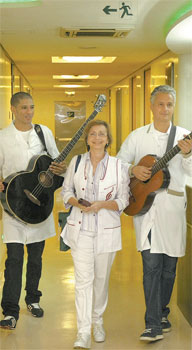
Fotografia: Luiz Carlos Murauskas/Folha Imagem | Musicoterapeutas da FMU no Hospital Paulistano, em SP
"A musicoterapia não só melhora o humor de pacientes hospitalizados como pode até antecipar a alta médica. É o que sugere um levantamento feito por uma equipe da FMU (Faculdades Metropolitanas Unidas), que desenvolveu um projeto nos hospitais Paulistano e TotalCor, em São Paulo, e Bezerra de Menezes, em São Bernardo do Campo (SP).

Dos cem pacientes ouvidos, 90% tiveram melhora do estado emocional, medida por questionários aplicados no início e no fim da sessão. Em 72% dos casos, houve antecipação da alta médica, avaliada pelo depoimento de psicólogos e médicos.

Segundo Maristela Smith, coordenadora do curso de musicoterapia da FMU, a melhora no humor não acontece só no momento em que a equipe atua. "A música provoca efeitos bioquímicos. Atua em neurotransmissores como a serotonina e enriquece os circuitos neurais, o que intensifica o prazer. Esses benefícios não ocorrem só na hora. Deixam um resíduo."

No projeto, são usados instrumentos como flauta doce, violão, baixo e vários de percussão. Em uma entrevista, monta-se a história sonora do paciente, que inclui seus ritmos preferidos. No quarto, os musicoterapeutas tocam, por cerca de 20 minutos, canções conhecidas e com mensagens de otimismo e bem-estar, e também compõem músicas para cada paciente, baseadas em suas preferências.

Os estilos mais pedidos foram MPB (37%), clássico (18%) e sertanejo (15%). Roberto Carlos foi o intérprete preferido. A maioria dos pacientes tinha mais de 50 anos.

Para Alze Tavares, coordenador médico do Hospital Paulistano, pacientes de qualquer idade são beneficiados. "Eles adoram, ficam mais dispostos. A música reduz a insônia, tem impacto nas frequências cardíacas e respiratórias e até na pressão. O humor melhora e o relacionamento com os profissionais de saúde também."

No segundo semestre, a FMU pretende expandir o projeto para outros hospitais e fazer um trabalho a longo prazo com cada paciente." (FLÁVIA MANTOVANI | EDITORA-ASSISTENTE DO EQUILÍBRIO)

  © Blogger template 'The Base' by Ourblogtemplates.com 2008. Adapted by Margarida Azevedo (Março, 29, 2009).

Back to TOP